

What's New
Recently Released Resources
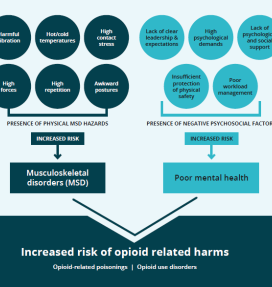
Preventing MSD to Reduce Opioid Use
This poster shows the association between MSD, mental health, and risk of opioid use in the working population.
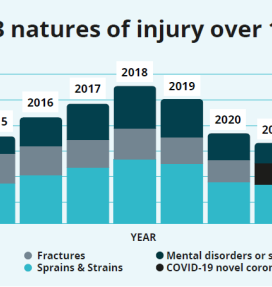
Impact of MSD in Ontario Workplaces
This poster shows the financial impact of MSD in workplaces over the last 10 years and in 2023.
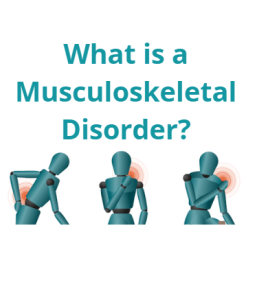
What is a Musculoskeletal Disorder (MSD)?
This video introduces common symptoms, MSD hazards, and how to prevent MSD injuries.
Introduction to the MSD Prevention Guideline Website
This video provides an overview of the sections and content available on the website.
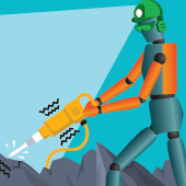
MLITSD Northern Region Mining Initiative on Hand-Arm Vibration
In 2025, the Ministry of Labour, Immigration, Training and Skills Development (MLITSD) is launching a focused initiative on hand-arm vibration (HAV) exposure in Northern Ontario’s mining sector—and employers need to be prepared. A free webinar on Tuesday, August 19 at 10:30 am ET, hosted by Ontario's health and safety system partners, will introduce the goals of the initiative and explain how HAV fits into the broader picture of mining risk management.
HAV-related health effects fall within the category of occupational illnesses with specific reporting requirements under the OHSA, but historically overlooked and misunderstood within the broader context of workplace hazard assessment and control.
Like other physical hazards, HAV exposure can—and should—be assessed using screening tools and measurement against established standards. Learn how Ontario’s health and safety system partners are supporting this initiative and how they can help to "shake off" the risks of this often-overlooked hazard.
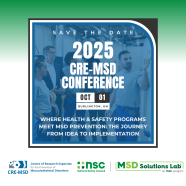
Save the Date: CRE-MSD Annual Conference
Where Health & Safety Programs Meet MSD Prevention: The Journey From Idea to Implementation
October 1, 2025 | Burlington, Ontario
Join us on October 1, 2025 to kick off Global Ergonomics Month! This conference will include case studies of program implementation strategies from a wide range of industries. Learn how evidence-based approaches have been implemented to create impactful outcomes such as cost savings, increased productivity, and reduction in MSD.
CRE-MSD is proud to partner with MSD Solutions Lab of the National Safety Council to bring you this year’s conference. Join us on October 1, for this hybrid event with all speakers presenting in person at the conference venue in Burlington, Ontario. Don’t miss this opportunity to gain insights into the lessons learned from organizations on their MSD prevention journey.
Watch the CRE-MSD events page for more details coming soon.
Presenters: Dr. Michael Holmes & Lex Napper, AE
Arborists have a 15 times greater risk of fatality and three times greater risk of non-fatal injury when compared to the North American average. Workers are not only exposed to repetitive tasks with forceful exertions, but also vibration, noise, and environmental factors, which all contribute to the risk of injury.
This webinar will share the results of research that examined hand-arm vibration to the upper extremity in arborists while completing common tree abatement tasks, as well as the effects of these exposures on fine motor control. The results of this research have implications for cut types and directions that have the largest vibration transmission to workers, providing a first step for work practices that reduce overall vibration exposure in arborists.
Presenter: Dr. Bob Fox
What’s new in the world of ergonomics standards? Have you ever wondered what exactly is a standard, what role it plays, how it got developed and by whom, who implements it, and the impact it has?
This webinar will address the development of ergonomics standards specifically related to musculoskeletal disorders (MSD), the community engagement and revision processes, their implementation in the workplace, and ultimately, the benefits they provide to occupational health and safety. Examples of MSD standards developed by the International Organization for Standardization (ISO) and other standards-making organizations will be shared. This webinar will be of interest to all practitioners and researchers seeking to prevent MSD and understand how and where they can engage in standards work.
This webinar is co-hosted by CRE-MSD and the International Ergonomics Association (IEA) Technical Committee on Musculoskeletal Disorders.